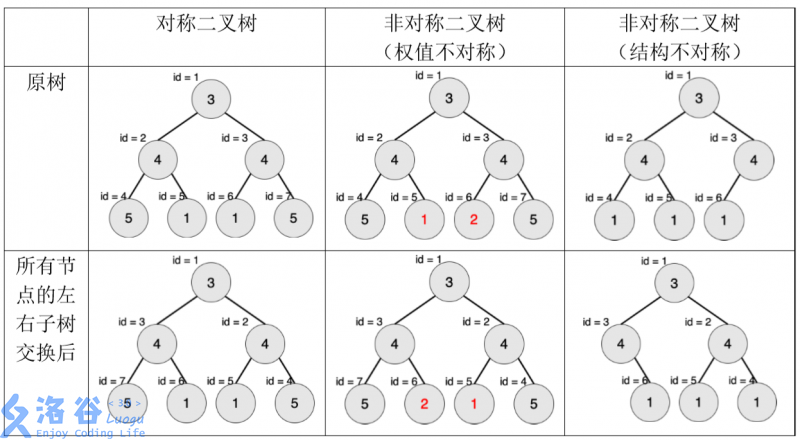
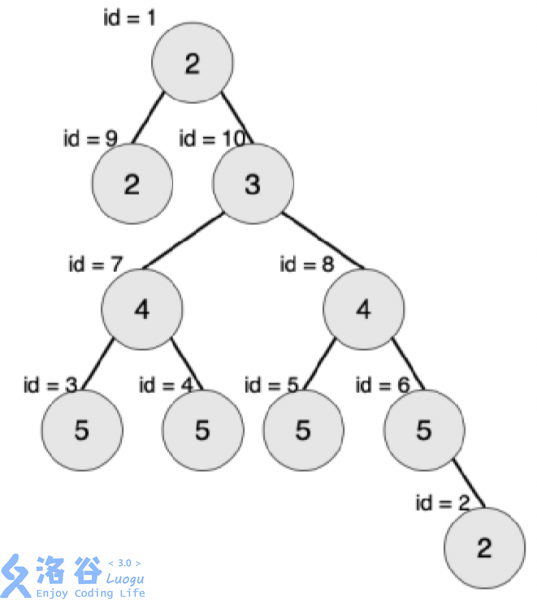
求点权有根树中最大的对称二叉子树:枚举对称中心,自底向上镜像判定(左右子树互换后同构且点权相同),记忆化 + 迭代栈,O(n^2)。
OJ: roj
题目 ID: 3657
难度:提高+/省选-
标签:树二叉树记忆化搜索NOIP
创建: 2026-10-02 14:15
更新: 2026-10-10 11:30
形式化题目
正解
思路
1. 镜像判定
两棵子树 L[a] 与 R[b] 互为镜像且 R[a] 与 L[b] 互为镜像,且对应点权相等。自底向上递推,同一节点对只算一次(记忆化)。
2. 枚举中心
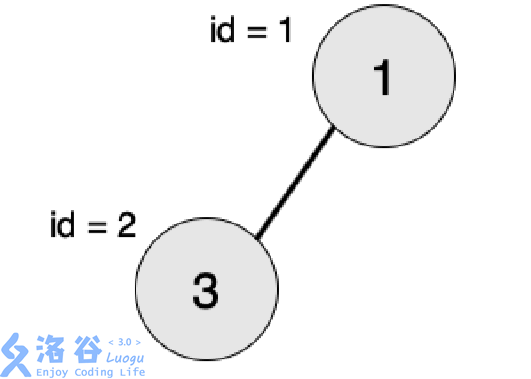
对每个节点作为「对称中心」,检查其左右子树互为镜像;中心也可以是点权对称的相邻两节点(按题面定义)。答案取所有成立情形的最大节点数。
递归深度可能达到
代码
cpp
/**
* Author by Rainboy blog: https://rainboylv.com github: https://github.com/rainboylvx
* rbook: -> https://rbook.roj.ac.cn https://rbook2.roj.ac.cn
* rainboy的学习导航网站: https://idx.roj.ac.cn
* create_at: 2026-10-10 11:30
* update_at: 2026-10-10 11:30
*/
#include <bits/stdc++.h>
using namespace std;
typedef long long ll;
vector<int> VAL,Lc,Rc; map<pair<int,int>, bool> MEMO;
bool mirror_tree(int a,int b){ if(a<0||b<0) return a<0&&b<0; vector<array<int,3> > st; st.push_back({a,b,0}); while(!st.empty()){array<int,3> cur=st.back(); st.pop_back(); int x=cur[0],y=cur[1],stage=cur[2]; if(x<0||y<0) continue; pair<int,int> key={x,y}; if(stage){int lx=Lc[x], ry=Rc[y], rx=Rc[x], ly=Lc[y]; bool aok=MEMO.count({lx,ry})?MEMO[{lx,ry}]:(lx<0&&ry<0); bool bok=MEMO.count({rx,ly})?MEMO[{rx,ly}]:(rx<0&&ly<0); MEMO[key]=aok&&bok;} else if(MEMO.count(key)) continue; else if(VAL[x]!=VAL[y]) MEMO[key]=false; else {st.push_back({x,y,1}); st.push_back({Lc[x],Rc[y],0}); st.push_back({Rc[x],Lc[y],0});}} return MEMO[{a,b}];}
int main(){ios::sync_with_stdio(false);cin.tie(nullptr); int n; if(!(cin>>n)) return 0; VAL.assign(n+1,0); for(int i=1;i<=n;i++) cin>>VAL[i]; Lc.assign(n+1,0); Rc.assign(n+1,0); for(int i=1;i<=n;i++) cin>>Lc[i]>>Rc[i]; vector<int> order, st; st.push_back(1); while(!st.empty()){int x=st.back();st.pop_back(); order.push_back(x); if(Lc[x]>0) st.push_back(Lc[x]); if(Rc[x]>0) st.push_back(Rc[x]);} vector<int> sz(n+1); int best=0; for(int i=(int)order.size()-1;i>=0;i--){int x=order[i]; int sub=1+(Lc[x]>0?sz[Lc[x]]:0)+(Rc[x]>0?sz[Rc[x]]:0); sz[x]=sub; if(sub>best && mirror_tree(Lc[x],Rc[x])) best=sub;} cout<<best<<'\n'; return 0;}python
#!/usr/bin/env python3
# Author by Rainboy blog: https://rainboylv.com github: https://github.com/rainboylvx
# rbook: -> https://rbook.roj.ac.cn https://rbook2.roj.ac.cn
# rainboy的学习导航网站: https://idx.roj.ac.cn
# create_at: 2026-10-02 13:52
# update_at: 2026-10-02 13:52
import sys
VAL: list[int] = [] # 点权,下标即节点编号,0 号位补 0 占位
L: list[int] = [] # 左孩子编号,-1 表示不存在
R: list[int] = [] # 右孩子编号,-1 表示不存在
# 镜像判定缓存:同一对节点只展开一次,key = (a, b)
MEMO: dict[tuple[int, int], bool] = {}
def mirror(a: int, b: int) -> bool:
"""以 a、b 为根的两棵子树是否互为镜像(交换后结构与点权都相同)。"""
if a < 0 or b < 0: # 只有一侧为空就谈不上镜像
return a < 0 and b < 0
stack: list[tuple[int, int, int]] = [(a, b, 0)] # (节点对, 阶段):0 去下探,1 回收
while stack:
x, y, stage = stack.pop()
if x < 0 or y < 0: # 空树对的结论即时成立,不占缓存
continue
key = (x, y)
if stage: # 两个子对已在栈上方判完,按子对结果汇总
lx, ry = L[x], R[y]
rx, ly = R[x], L[y]
MEMO[key] = MEMO.get((lx, ry), lx < 0 and ry < 0) and MEMO.get(
(rx, ly), rx < 0 and ly < 0
)
elif key in MEMO: # 该节点对早已判定,直接复用
continue
elif VAL[x] != VAL[y]: # 根权不同,不必再看子树
MEMO[key] = False
else: # 下探两对交叉孩子:左对右、右对左
stack.append((x, y, 1))
stack.append((L[x], R[y], 0))
stack.append((R[x], L[y], 0))
return MEMO[(a, b)]
def largest_symmetric() -> int:
"""后序累计子树大小,返回对称子树里最大的节点数。"""
order: list[int] = []
stack = [1]
while stack: # 迭代先序收集遍历序,倒着走就是孩子先于父亲
x = stack.pop()
order.append(x)
if L[x] > 0:
stack.append(L[x])
if R[x] > 0:
stack.append(R[x])
size = [0] * len(VAL)
best = 0
for x in reversed(order):
left, right = L[x], R[x]
size[x] = sub = 1 + (size[left] if left > 0 else 0) + (size[right] if right > 0 else 0)
can_beat = sub > best # 更小的候选更新不了答案,连镜像判定一起省掉
if can_beat and mirror(left, right):
best = sub
return best
def solve() -> None:
data = iter(map(int, sys.stdin.buffer.read().split()))
global VAL, L, R
n = next(data) # 节点数,编号 1~n,1 是树根
VAL = [0] + [next(data) for _ in range(n)]
L = [0] * (n + 1)
R = [0] * (n + 1)
for i in range(1, n + 1): # 第 i 行是节点 i 的左、右孩子编号
L[i] = next(data)
R[i] = next(data)
print(largest_symmetric())
if __name__ == "__main__":
solve()复杂度
- 时间复杂度:
最坏(每个中心线性验证,记忆化共享子对)。 - 空间复杂度:
。
总结
- 「对称子树」= 镜像同构判定 + 枚举中心,镜像关系传递成记忆化子问题。
- Python 树递归一律显式栈两阶段(下探/回收),规避递归深度与栈开销。