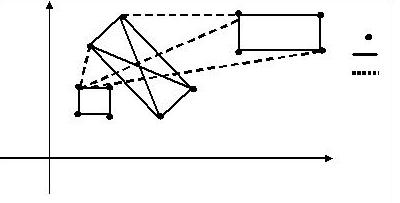
把每个机场建成图上的点:用直角顶点补出矩形第 4 个机场,同城连铁路、异城连航线,多源 Dijkstra 求 A 城到 B 城的最少花费。
OJ: roj
题目 ID: 3511
难度:普及+/提高-
标签:图论最短路Dijkstra计算几何python
创建: 2026-10-02 04:41
更新: 2026-10-10 11:30
形式化题目
有
以样例为例:47.5:
输入
1
3 10 1 3
1 1 1 3 3 1 30
2 5 7 4 5 2 1
8 6 8 8 11 6 3
输出
47.5正解
思路
先看朴素想法为什么不行。最直接的建模是「把一座城市压成一个点」:但一条航段的花费取决于从哪个机场起飞、在哪个机场降落,降落机场又决定城内铁路要走多远才能接上下一段——城市粒度的状态丢掉了「从哪个机场进出」,答案会算错。若把状态细化到机场,却按「枚举中转城市序列 + 每段贪心选最便宜机场」来做,中转序列有指数多种;而且相邻两段共用同一个中转机场,两段的机场选择互相耦合,贪心也不成立。
两个朴素做法共同的瓶颈是:路线任意,且相邻两段的机场衔接互相耦合。这恰好是最短路模型的适用场景——把「衔接」显式地写成边,让算法去枚举所有可能的衔接方式。
于是推导分三步。
第一步:补出第 4 个机场。 矩形按环序为
实现时只需在三个已知点里找点积为
| 城市 | 已知三点 | 直角顶点 |
另两点 |
第四点 |
|---|---|---|---|---|
| 1 | (1, 1)、(1, 3)、(3, 1) | (1, 1) | (1, 3)、(3, 1) | (3, 3) |
| 2 | (2, 5)、(7, 4)、(5, 2) | (5, 2) | (2, 5)、(7, 4) | (4, 7) |
| 3 | (8, 6)、(8, 8)、(11, 6) | (8, 6) | (8, 8)、(11, 6) | (11, 8) |
第二步:把机场建成图上的点。 粒度必须细到「(城市, 机场编号)」,全图共
- 同城边:每座城市
条铁路,边权 = 欧氏距离 ; - 异城边:每对城市
条航线,边权 = 欧氏距离 。
这样任何一条合法路线都对应图上一条路径,反之亦然,边权全部为正。
第三步:多源 Dijkstra。 「出发机场任选」等价于把 main.py 的 rect_fourth(补点)、build_graph(建图)与 min_fare(多源 Dijkstra)。
回到样例:城 1 铁路单价 30 太贵,最优路线完全不走城 1 的铁路,而是从 f"{fare:.1f}" 四舍五入到一位小数,避免中途舍入误差。
代码
/**
* Author by Rainboy blog: https://rainboylv.com github: https://github.com/rainboylvx
* rbook: -> https://rbook.roj.ac.cn https://rbook2.roj.ac.cn
* rainboy的学习导航网站: https://idx.roj.ac.cn
* create_at: 2026-10-10 11:30
* update_at: 2026-10-10 11:30
*/
#include <bits/stdc++.h>
using namespace std;
typedef long long ll;
// 矩形三个顶点补出第四个顶点:直角顶点为 c,另两点 a、b,第四顶点 = a + b - c
pair<int, int> rect_fourth(pair<int, int> a, pair<int, int> b, pair<int, int> c) {
// c 是直角顶点
return make_pair(a.first + b.first - c.first, a.second + b.second - c.second);
}
// 已知三点求第四个顶点
pair<int, int> rect_fourth_from_three(pair<int, int> p1, pair<int, int> p2, pair<int, int> p3) {
pair<int, int> pts[3] = {p1, p2, p3};
for (int i = 0; i < 3; i++) {
pair<int, int> c = pts[i];
pair<int, int> a = pts[(i + 1) % 3];
pair<int, int> b = pts[(i + 2) % 3];
ll dot = (ll)(a.first - c.first) * (b.first - c.first)
+ (ll)(a.second - c.second) * (b.second - c.second);
if (dot == 0) return rect_fourth(a, b, c);
}
return make_pair(0, 0);
}
int main() {
ios::sync_with_stdio(false);
cin.tie(nullptr);
int cases;
cin >> cases;
cout << fixed << setprecision(1);
while (cases--) {
int city_count, fly_price;
cin >> city_count >> fly_price;
int start, end;
cin >> start >> end;
int total = city_count * 4;
vector<pair<int, int> > airports(total);
vector<int> rail(city_count);
for (int c = 0; c < city_count; c++) {
pair<int, int> p1, p2, p3;
cin >> p1.first >> p1.second;
cin >> p2.first >> p2.second;
cin >> p3.first >> p3.second;
cin >> rail[c];
int base = c * 4;
airports[base + 0] = p1;
airports[base + 1] = p2;
airports[base + 2] = p3;
airports[base + 3] = rect_fourth_from_three(p1, p2, p3);
}
// 建图
vector<vector<pair<int, double> > > adj(total);
for (int c = 0; c < city_count; c++) {
int base = c * 4;
for (int i = 0; i < 4; i++) {
for (int j = i + 1; j < 4; j++) {
double dx = airports[base + i].first - airports[base + j].first;
double dy = airports[base + i].second - airports[base + j].second;
double w = sqrt(dx * dx + dy * dy) * rail[c];
adj[base + i].push_back(make_pair(base + j, w));
adj[base + j].push_back(make_pair(base + i, w));
}
}
}
for (int c = 0; c < city_count; c++) {
int base = c * 4;
for (int c2 = c + 1; c2 < city_count; c2++) {
int base2 = c2 * 4;
for (int i = 0; i < 4; i++) {
for (int j = 0; j < 4; j++) {
double dx = airports[base + i].first - airports[base2 + j].first;
double dy = airports[base + i].second - airports[base2 + j].second;
double w = sqrt(dx * dx + dy * dy) * fly_price;
adj[base + i].push_back(make_pair(base2 + j, w));
adj[base2 + j].push_back(make_pair(base + i, w));
}
}
}
}
// 多源 Dijkstra:4 个起点并入,任一终点到达即停
int base_a = (start - 1) * 4;
int base_b = (end - 1) * 4;
vector<double> dist(total, 1e18);
priority_queue<pair<double, int>, vector<pair<double, int> >, greater<pair<double, int> > > pq;
for (int i = 0; i < 4; i++) {
dist[base_a + i] = 0.0;
pq.push(make_pair(0.0, base_a + i));
}
double ans = 1e18;
while (!pq.empty()) {
double cost = pq.top().first;
int u = pq.top().second;
pq.pop();
if (cost > dist[u]) continue;
if (u >= base_b && u < base_b + 4) { ans = cost; break; }
for (size_t i = 0; i < adj[u].size(); i++) {
int v = adj[u][i].first;
double w = adj[u][i].second;
if (cost + w < dist[v]) {
dist[v] = cost + w;
pq.push(make_pair(cost + w, v));
}
}
}
cout << ans << "\n";
}
return 0;
}#!/usr/bin/env python3
# Author by Rainboy blog: https://rainboylv.com github: https://github.com/rainboylvx
# rbook: -> https://rbook.roj.ac.cn https://rbook2.roj.ac.cn
# rainboy的学习导航网站: https://idx.roj.ac.cn
# create_at: 2026-10-02 04:43
# update_at: 2026-10-02 04:43
import sys
from collections.abc import Iterable
from heapq import heappop, heappush
from math import hypot
def rect_fourth(pts: list[tuple[int, int]]) -> tuple[int, int]:
"""矩形三个顶点补出第四个顶点。
三个已知点里恰有一个顶点的两条邻边都在已知点中(直角顶点),记它为 c、
另两点为 a、b,则第四个顶点 = a + b - c(对角线互相平分)。
"""
for i, (cx, cy) in enumerate(pts):
(ax, ay), (bx, by) = [p for j, p in enumerate(pts) if j != i]
if (ax - cx) * (bx - cx) + (ay - cy) * (by - cy) == 0: # a、b 在 c 处张成直角
return ax + bx - cx, ay + by - cy
raise ValueError("三个点构不成矩形顶点") # 题面保证不会走到这里
def build_graph(
airports: list[tuple[int, int]],
rail: list[int],
fly_price: int,
) -> list[list[tuple[int, float]]]:
"""把每个机场建成图上的一个点:同城机场两两修铁路,异城机场两两修航线。"""
city_count = len(rail)
adj: list[list[tuple[int, float]]] = [[] for _ in range(city_count * 4)]
for c in range(city_count):
base = c * 4
for i in range(4): # 同城 6 条铁路,单价 Ti
xi, yi = airports[base + i]
for j in range(i + 1, 4):
xj, yj = airports[base + j]
rail_cost = hypot(xi - xj, yi - yj) * rail[c]
adj[base + i].append((base + j, rail_cost))
adj[base + j].append((base + i, rail_cost))
for c2 in range(c + 1, city_count): # 异城 4x4=16 条航线,单价 t
base2 = c2 * 4
for i in range(4):
xi, yi = airports[base + i]
for j in range(4):
xj, yj = airports[base2 + j]
fly_cost = hypot(xi - xj, yi - yj) * fly_price
adj[base + i].append((base2 + j, fly_cost))
adj[base2 + j].append((base + i, fly_cost))
return adj
def min_fare(adj: list[list[tuple[int, float]]], sources: Iterable[int], targets: set[int]) -> float:
"""多源 Dijkstra:从任一 source 出发、到任一 target 的最少花费,首次弹出 target 即答案。"""
dist = [float("inf")] * len(adj)
heap: list[tuple[float, int]] = []
for s in sources:
dist[s] = 0.0
heappush(heap, (0.0, s))
while heap:
cost, u = heappop(heap)
if cost > dist[u]: # 过期堆元素
continue
if u in targets: # 第一个弹出的目标点已被最短路覆盖
return cost
for v, w in adj[u]:
if cost + w < dist[v]:
dist[v] = cost + w
heappush(heap, (cost + w, v))
return float("inf") # 航线全连通,实际不可达
def solve() -> None:
data = iter(map(int, sys.stdin.buffer.read().split()))
out: list[str] = []
cases = next(data)
for _ in range(cases):
city_count, fly_price = next(data), next(data)
start, end = next(data), next(data) # 出发城市 A、到达城市 B 的序号
airports: list[tuple[int, int]] = []
rail: list[int] = [] # 每城铁路单价 Ti,与 airports 按 4 个一组对齐
for _ in range(city_count):
pts = [(next(data), next(data)) for _ in range(3)]
rail.append(next(data)) # 题面每行末尾的 Ti:该城铁路单位里程价格
airports += [*pts, rect_fourth(pts)]
adj = build_graph(airports, rail, fly_price)
base_a, base_b = (start - 1) * 4, (end - 1) * 4
# 出发、到达机场都可以任选:4 个起点并入、4 个终点任一到达即停
fare = min_fare(
adj,
range(base_a, base_a + 4),
set(range(base_b, base_b + 4)),
)
out.append(f"{fare:.1f}")
print("\n".join(out))
if __name__ == "__main__":
solve()复杂度
- 时间:补点
;建图共 条边;堆优化 Dijkstra 为 。 时 、 ,实测每组约 0.02s。 - 空间:邻接表
,实测峰值约 16MB。
总结
把「机场」而不是「城市」作为状态粒度:先用直角顶点补出矩形的第 4 个机场,再按「同城铁路、异城航线」两类边把题面直接翻译成一张正权无向图,最后用多源 Dijkstra(起点端 4 点初值 0、首次弹出终点城市即返回)求出最小花费。核心是识别出「相邻两段的机场衔接」必须交给最短路枚举,而不是贪心。
图示解析
这张图串起样例从补点、建模到得到答案的主线(异城航线两两全连,图中只画出最优路线用到的三段):
flowchart LR
    subgraph city1["城市 1(铁路单价 30)"]
        a0["机场1 (1, 1)"]
        a1["机场2 (1, 3)"]
        a2["机场3 (3, 1)"]
        a3["机场4 (3, 3)"]
    end
    subgraph city2["城市 2(铁路单价 1)"]
        b0["机场1 (2, 5)"]
        b1["机场2 (7, 4)"]
        b2["机场3 (5, 2)"]
        b3["机场4 (4, 7)"]
    end
    subgraph city3["城市 3(铁路单价 3)"]
        c0["机场1 (8, 6)"]
        c1["机场2 (8, 8)"]
        c2["机场3 (11, 6)"]
        c3["机场4 (11, 8)"]
    end
    a2 ==>|航线 22.4| b2
    b2 ==>|铁路 2.8| b1
    b1 ==>|航线 22.4| c0
    start["城 1 任选出发"]:::ghost -.-> a2
    c0 -.-> goal["城 3 任选到达"]:::ghost
    classDef ghost fill:#fff,stroke:#999,stroke-dasharray: 3 3
先看每个子图是一个城市的 4 个机场(含补出来的第 4 个),再顺着粗边看路线:城 1 铁路单价 30 太贵,所以不在城 1 走铁路,而是从机场 3 直接飞进城 2,用单价 1 的铁路换到更好的起飞位,再飞进城 3 的机场 1。三段花费