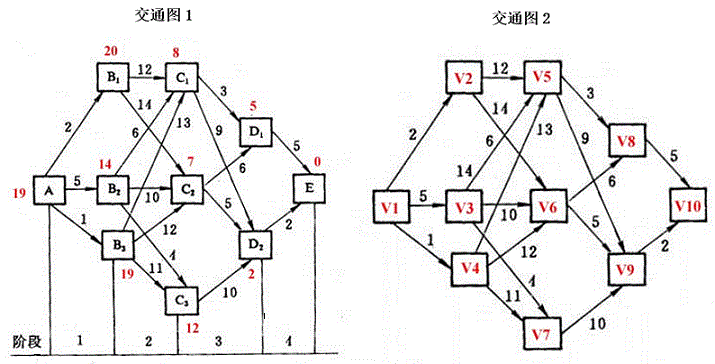
DAG 最短路:边只从小城市指向大城市,编号即拓扑序,逆序 DP f(i)=min(w(i,j)+f(j)) 并用 go 数组回溯,O(N²) 求 1→N 最小费用与路径。
OJ: roj
题目 ID: 1261
难度:普及-
标签:动态规划图论最短路python
创建: 2026-09-30 02:15
更新: 2026-10-05 07:19
题目描述
有 minlong=最小费用,第二行是路径上依次经过的城市编号(空格分隔)。样例:输入 10 及 10×10 矩阵(minlong=19 与 1 3 5 8 10。
思路
所有边都从小编号指向大编号,编号本身就是拓扑序,于是从 go[i] 记下取得最小值的后继,答案 go 回溯即得路径。总转移次数
参考代码
Python 版:
python
#!/usr/bin/env python3
# Author by Rainboy blog: https://rainboylv.com github: https://github.com/rainboylvx
# rbook: -> https://rbook.roj.ac.cn https://rbook2.roj.ac.cn
# rainboy的学习导航网站: https://idx.roj.ac.cn
# create_at: 2026-09-30 02:17
# update_at: 2026-09-30 02:17
import sys
INF = 10000005 # 不可达哨兵:费用非负、规模极小,真实答案到不了这个量级
def shortest(cost: list[list[int]]) -> tuple[int, list[int]]:
"""逆序 DAG 最短路 DP,返回 (从 1 到 n 的最短费用, 最短路径上的城市序列)。
边只从编号小的城市指向编号大的城市(与配图中 A→E 的方向一致),
所以从 n-1 倒着推到 0 时,所有后继的最优值都已算好——这正是逆拓扑序。
f[i] 记「从 i 到终点 n 的最短费用」,go[i] 记最短路上 i 的下一站。
"""
n = len(cost)
f: list[int] = [INF] * n
go: list[int] = [0] * n # 下一站的城市编号(1 起),0 表示不可达或已是终点
f[n - 1] = 0 # 终点到自身的费用为 0
for i in range(n - 2, -1, -1):
best, nxt = f[i], 0 # 保留 "没有更优后继" 的初值,回溯时靠 go=0 停止
for j in range(i + 1, n):
w = cost[i][j]
if w and w + f[j] < best: # 费用为 0 表示没有直通边;严格小于让平手时保序
best, nxt = w + f[j], j + 1
f[i], go[i] = best, nxt
# 从 1 号城市沿 go 逐跳回溯,到终点(go 为 0)自然停下
path: list[int] = [1]
k = go[0]
while k:
path.append(k)
k = go[k - 1]
return f[0], path
def solve() -> None:
nums = iter(map(int, sys.stdin.buffer.read().split()))
n = next(nums) # 城市数量
# N×N 费用矩阵:cost[i][j] 是 i→j 的直通费用,0 表示两点间没有直通边
cost = [[next(nums) for _ in range(n)] for _ in range(n)]
total, path = shortest(cost)
print(f"minlong={total}")
print(*path)
if __name__ == "__main__":
solve()C++ 版(同一算法):
cpp
/**
* Author by Rainboy blog: https://rainboylv.com github: https://github.com/rainboylvx
* rbook: -> https://rbook.roj.ac.cn https://rbook2.roj.ac.cn
* rainboy的学习导航网站: https://idx.roj.ac.cn
* create_at: 2026-10-05 07:19
* update_at: 2026-10-05 07:19
*/
#include <bits/stdc++.h>
using namespace std;
typedef long long ll;
const int MAXN = 25;
const ll INF = 1000000000000000000LL;
int n; // 城市数量
ll w[MAXN][MAXN]; // w[i][j]:城市 i 直达城市 j 的费用,0 表示没有直通边
ll f[MAXN]; // f[i]:从城市 i 到城市 n 的最小费用
int go[MAXN]; // go[i]:最优路线上从城市 i 出发的下一站,0 表示终点或不可达
int main() {
ios::sync_with_stdio(false);
cin.tie(nullptr);
cin >> n;
for (int i = 1; i <= n; i++) {
for (int j = 1; j <= n; j++) {
cin >> w[i][j];
}
}
// 所有边都是小编号指向大编号,编号即拓扑序,从 n 倒着推就是逆拓扑序 DP
for (int i = 1; i <= n; i++) {
f[i] = INF;
}
f[n] = 0;
for (int i = n - 1; i >= 1; i--) {
for (int j = i + 1; j <= n; j++) {
if (w[i][j] != 0 && w[i][j] + f[j] < f[i]) {
f[i] = w[i][j] + f[j];
go[i] = j;
}
}
}
cout << "minlong=" << f[1] << "\n";
// 从城市 1 沿 go 逐跳回溯到 n,输出路径上的城市编号
int cur = 1;
cout << cur;
while (go[cur] != 0) {
cur = go[cur];
cout << " " << cur;
}
cout << "\n";
return 0;
}