[SHOI2012] 回家的路
把每个关键交点拆成“横线状态”和“竖线状态”两个点;同一条线上的相邻关键点连边,换乘站内部连一条代价为 1 的边,再在这张图上跑最短路。
OJ: luogu
题目 ID: P3831
难度:提高+/省选-
标签:最短路图论堆思维
日期: 2026-06-20 04:52
题意
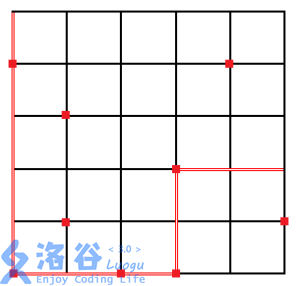
有一个 n × n 的地铁网格,每个交点都是一个站。
- 走过相邻两个站,花
2分钟 - 只有给出的
m个换乘站,才能在站内从横线换到竖线,花1分钟
从学校 (sx, sy) 回家 (tx, ty),问最少需要多少时间。
如果根本到不了,就输出 -1。
思路
先看一个最直接的小数据暴力:
#include <bits/stdc++.h>
using namespace std;
const int MAXN = 10;
const int MAXV = MAXN * MAXN * 2 + 5;
const long long INF = (1LL << 60);
struct HeapNode {
int u;
long long dist;
bool operator < (const HeapNode &other) const {
return dist > other.dist;
}
};
int n, m;
bool can_transfer[MAXN][MAXN];
int sx, sy, tx, ty;
vector<pair<int, int> > g[MAXV];
long long dist_arr[MAXV];
bool vis[MAXV];
int row_id(int x, int y) {
return ((x - 1) * n + (y - 1)) * 2 + 1;
}
int col_id(int x, int y) {
return ((x - 1) * n + (y - 1)) * 2 + 2;
}
void add_edge(int u, int v, int len) {
g[u].push_back(make_pair(v, len));
}
void build_graph() {
int tot = n * n * 2;
for (int i = 1; i <= tot; i++) {
g[i].clear();
}
for (int x = 1; x <= n; x++) {
for (int y = 1; y <= n; y++) {
if (y + 1 <= n) {
add_edge(row_id(x, y), row_id(x, y + 1), 2);
add_edge(row_id(x, y + 1), row_id(x, y), 2);
}
if (x + 1 <= n) {
add_edge(col_id(x, y), col_id(x + 1, y), 2);
add_edge(col_id(x + 1, y), col_id(x, y), 2);
}
if (can_transfer[x][y]) {
add_edge(row_id(x, y), col_id(x, y), 1);
add_edge(col_id(x, y), row_id(x, y), 1);
}
}
}
}
int main() {
ios::sync_with_stdio(false);
cin.tie(nullptr);
cin >> n >> m;
for (int i = 1; i <= n; i++) {
for (int j = 1; j <= n; j++) {
can_transfer[i][j] = false;
}
}
for (int i = 1; i <= m; i++) {
int x, y;
cin >> x >> y;
can_transfer[x][y] = true;
}
cin >> sx >> sy >> tx >> ty;
build_graph();
int tot = n * n * 2;
for (int i = 1; i <= tot; i++) {
dist_arr[i] = INF;
vis[i] = false;
}
priority_queue<HeapNode> pq;
dist_arr[row_id(sx, sy)] = 0;
dist_arr[col_id(sx, sy)] = 0;
pq.push({row_id(sx, sy), 0});
pq.push({col_id(sx, sy), 0});
while (!pq.empty()) {
HeapNode cur = pq.top();
pq.pop();
int u = cur.u;
if (vis[u]) {
continue;
}
vis[u] = true;
for (size_t i = 0; i < g[u].size(); i++) {
int v = g[u][i].first;
long long nd = dist_arr[u] + g[u][i].second;
if (nd < dist_arr[v]) {
dist_arr[v] = nd;
pq.push({v, nd});
}
}
}
long long answer = min(dist_arr[row_id(tx, ty)], dist_arr[col_id(tx, ty)]);
if (answer >= INF / 2) {
cout << -1 << '\n';
}
else {
cout << answer << '\n';
}
return 0;
}brute.cpp 直接在整个 n × n 网格上建状态图:
- 每个站拆成两个状态:
- 正在坐横线
- 正在坐竖线
- 横线状态只能在同一行左右走
- 竖线状态只能在同一列上下走
- 如果这个站是换乘站,就在两个状态之间连一条权值
1的边
这个做法最贴题意,但点数会膨胀到 2n^2。
本题 n 最大有 20000,显然不可能这样直接建。
关键观察是:
- 真正有决策意义的点,只有:
- 换乘站
- 起点
- 终点
因为在同一条横线或竖线上,如果中间一长串站都不能换乘,那么人只会“直着坐过去”,中间那些站不会产生新的选择。
所以我们只需要保留这些关键点。
1. 状态拆点
对于每个关键点 (x,y),拆成两个点:
row(x,y):表示你现在坐在横线里col(x,y):表示你现在坐在竖线里
如果这个关键点本身是换乘站,那么:
row(x,y) <-> col(x,y)连一条权值1的边
这张图表示的就是这个拆点动作:
flowchart LR
  A["row(x,y)"] <-->|1| B["col(x,y)"]
这条边只在“能换乘”的站存在。
起点和终点就算和某个换乘站重合,我们也不额外发明规则,照样放进图里处理。
2. 同线只连相邻关键点
现在考虑同一行上的若干关键点。
如果它们按列坐标排好序是:
p1, p2, p3, ...
那么在横线状态里,只需要连:
p1 <-> p2p2 <-> p3- …
边权就是站数差乘 2。
原因很简单:
在同一条线里直着坐,路费满足三角形关系。
如果你想从更左边去更右边,经过中间关键点拆成若干段,总代价和直接按站数计算是一样的。
所以只保留相邻关键点,就不会丢失最短路。
同一列完全同理。
样例结构图
这张图展示“关键点拆状态 + 同线相邻连边”的结构:
graph G {
  rankdir=LR;
  A [label="row(1,1)"];
  B [label="row(1,2)"];
  C [label="col(1,2)"];
  D [label="col(2,2)"];
  A -- B [label="2"];
  B -- C [label="1"];
  C -- D [label="2"];
}
它对应的正是:
- 先沿横线坐一站
- 在换乘站切到竖线
- 再沿竖线坐一站
这和题面的真实过程是一一对应的。
3. 起点和终点怎么处理
出发时你就在学校站里,所以:
- 可以直接选择先坐横线
- 也可以直接选择先坐竖线
都不需要额外换乘时间。
因此 Dijkstra 初始化时,把起点的两个状态距离都设成 0 即可。
终点同理,只要到达:
row(tx,ty)或col(tx,ty)
任意一个状态,都算到家了。
代码
#include <bits/stdc++.h>
using namespace std;
const int MAXP = 100000 + 5;
const int MAXV = MAXP * 2 + 10;
const int MAXE = 1200000 + 5;
const long long INF = (1LL << 60);
struct HeapNode {
int u;
long long dist;
bool operator < (const HeapNode &other) const {
return dist > other.dist;
}
};
int n, m;
int px[MAXP], py[MAXP];
bool can_transfer[MAXP];
int point_cnt;
int sx, sy, tx, ty;
int head[MAXV], to[MAXE], nxt[MAXE], w[MAXE], edge_cnt;
long long dist_arr[MAXV];
bool vis[MAXV];
int row_order[MAXP], col_order[MAXP];
int row_id(int id) {
return id * 2 - 1;
}
int col_id(int id) {
return id * 2;
}
bool cmp_row(int a, int b) {
if (px[a] != px[b]) {
return px[a] < px[b];
}
if (py[a] != py[b]) {
return py[a] < py[b];
}
return a < b;
}
bool cmp_col(int a, int b) {
if (py[a] != py[b]) {
return py[a] < py[b];
}
if (px[a] != px[b]) {
return px[a] < px[b];
}
return a < b;
}
void init_graph() {
edge_cnt = 0;
for (int i = 1; i <= row_id(point_cnt) + 1; i++) {
head[i] = 0;
}
}
void add_edge(int u, int v, int len) {
edge_cnt++;
to[edge_cnt] = v;
w[edge_cnt] = len;
nxt[edge_cnt] = head[u];
head[u] = edge_cnt;
}
void build_graph() {
init_graph();
// 换乘站可以在站内从横线切到竖线,代价 1。
for (int i = 1; i <= m; i++) {
add_edge(row_id(i), col_id(i), 1);
add_edge(col_id(i), row_id(i), 1);
}
for (int i = 1; i <= point_cnt; i++) {
row_order[i] = i;
col_order[i] = i;
}
sort(row_order + 1, row_order + point_cnt + 1, cmp_row);
sort(col_order + 1, col_order + point_cnt + 1, cmp_col);
// 同一横线上的关键点,只需要连相邻的两个。
for (int i = 2; i <= point_cnt; i++) {
int a = row_order[i - 1];
int b = row_order[i];
if (px[a] != px[b]) {
continue;
}
int len = (py[b] - py[a]) * 2;
add_edge(row_id(a), row_id(b), len);
add_edge(row_id(b), row_id(a), len);
}
// 同一竖线上的关键点,也只需要连相邻两个。
for (int i = 2; i <= point_cnt; i++) {
int a = col_order[i - 1];
int b = col_order[i];
if (py[a] != py[b]) {
continue;
}
int len = (px[b] - px[a]) * 2;
add_edge(col_id(a), col_id(b), len);
add_edge(col_id(b), col_id(a), len);
}
}
void dijkstra(int start_point) {
int tot = point_cnt * 2;
for (int i = 1; i <= tot; i++) {
dist_arr[i] = INF;
vis[i] = false;
}
priority_queue<HeapNode> pq;
// 出发点可以直接选择坐横线或者竖线,不需要换乘时间。
dist_arr[row_id(start_point)] = 0;
dist_arr[col_id(start_point)] = 0;
pq.push({row_id(start_point), 0});
pq.push({col_id(start_point), 0});
while (!pq.empty()) {
HeapNode cur = pq.top();
pq.pop();
int u = cur.u;
if (vis[u]) {
continue;
}
vis[u] = true;
for (int i = head[u]; i != 0; i = nxt[i]) {
int v = to[i];
long long nd = dist_arr[u] + w[i];
if (nd < dist_arr[v]) {
dist_arr[v] = nd;
pq.push({v, nd});
}
}
}
}
int main() {
ios::sync_with_stdio(false);
cin.tie(nullptr);
cin >> n >> m;
point_cnt = m;
for (int i = 1; i <= m; i++) {
cin >> px[i] >> py[i];
can_transfer[i] = true;
}
cin >> sx >> sy >> tx >> ty;
point_cnt++;
px[point_cnt] = sx;
py[point_cnt] = sy;
int start_point = point_cnt;
point_cnt++;
px[point_cnt] = tx;
py[point_cnt] = ty;
int end_point = point_cnt;
build_graph();
dijkstra(start_point);
long long answer = min(dist_arr[row_id(end_point)], dist_arr[col_id(end_point)]);
if (answer >= INF / 2) {
cout << -1 << '\n';
}
else {
cout << answer << '\n';
}
return 0;
}复杂度
设关键点总数是:
m + 2
排序两次:
建图后的边数是线性的,因为每条横线、竖线只连相邻关键点。
最后跑一次 Dijkstra:
总复杂度:
空间复杂度:
总结
这题最关键的不是最短路模板,而是先把大网格压缩掉。
真正有用的想法只有两步:
- 只保留“会产生选择”的关键点
- 每个关键点拆成横线状态和竖线状态
一旦建图想清楚,后面就是一题标准的最短路。
一图流解析
这张图把本题的建模、关键转移、实现检查和训练方法压缩到一页,适合读完正文后复盘。