【模板】最近公共祖先(LCA)
用倍增表 up[u][j] 记录 2^j 级祖先,查询时先提深再同步跳,单次询问 O(log n)。
OJ: luogu
题目 ID: P3379
难度:普及
标签:LCA倍增树模板
日期: 2026-07-16 23:59
形式化题目
给定一棵以
思路
先看一个可以直接验证想法的朴素解:
/**
* Author by Rainboy blog: https://rainboylv.com github: https://github.com/rainboylvx
* rbook: -> https://rbook.roj.ac.cn https://rbook2.roj.ac.cn
* rainboy的学习导航网站: https://idx.roj.ac.cn
* create_at: 2026-08-12 22:28
* update_at: 2026-08-12 22:28
*/
#include <bits/stdc++.h>
using namespace std;
// brute.cpp:小数据暴力解,每次询问把 x 到根的路径整条标记出来,
// 再从 y 向上爬父亲,遇到的第一个已标记点就是最近公共祖先。
// 单次询问 O(n),只适合小数据对拍和帮助理解题意。
const int MAXN = 105;
int n, m, root;
vector<int> g[MAXN]; // 邻接表
int fa[MAXN]; // fa[u] 表示 u 的父亲,根的父亲为 0
int vis[MAXN]; // 本次询问标记 x 的祖先路径
// BFS 求每个点的父亲(根的父亲为 0)。
void build_fa() {
queue<int> que;
que.push(root);
fa[root] = 0;
while (!que.empty()) {
int u = que.front();
que.pop();
for (int i = 0; i < (int)g[u].size(); i++) {
int v = g[u][i];
if (v == fa[u]) {
continue;
}
fa[v] = u;
que.push(v);
}
}
}
// 暴力求 x, y 的最近公共祖先。
int lca_brute(int x, int y) {
// 从 x 一路向上走到根,沿途全部标记。
while (x != 0) {
vis[x] = 1;
x = fa[x];
}
// 从 y 向上爬,第一个已被标记的点就是最近公共祖先。
while (vis[y] == 0) {
y = fa[y];
}
return y;
}
int main() {
ios::sync_with_stdio(false);
cin.tie(nullptr);
cin >> n >> m >> root;
for (int i = 1; i < n; i++) {
int u, v;
cin >> u >> v;
g[u].push_back(v);
g[v].push_back(u);
}
build_fa();
for (int i = 1; i <= m; i++) {
int x, y;
cin >> x >> y;
memset(vis, 0, sizeof(vis));
cout << lca_brute(x, y) << '\n';
}
return 0;
}brute.cpp 对每个询问把 x 到根的整条路径标记出来,再从 y 向上爬父亲,遇到的第一个被标记结点就是 LCA:公共祖先就是两条到根路径的交点。单次询问
关键观察有两点:
- LCA 一定是两个点的祖先:问题等价于「两条到根路径的交点里深度最大的点」,只要能快速向上跳,就能快速找 LCA;
- 任意上跳距离可拆成二进制位:
,只要会跳 步,就能一次跳任意步。
于是预处理倍增祖先表:
先跳
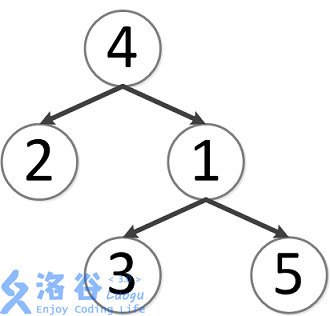
这张图是样例树(根为 4,2 与 1 是它的孩子,3 和 5 是 1 的孩子):

观察要点:
代码
/**
* Author by Rainboy blog: https://rainboylv.com github: https://github.com/rainboylvx
* rbook: -> https://rbook.roj.ac.cn https://rbook2.roj.ac.cn
* rainboy的学习导航网站: https://idx.roj.ac.cn
* create_at: 2026-08-12 22:28
* update_at: 2026-08-20 10:38
*/
#include <bits/stdc++.h>
using namespace std;
// main.cpp:P3379 最近公共祖先(LCA)正式解,直接使用 rbook 模板 lca-binary-lifting。
// 与模板的唯一差别:模板用递归 dfs 预处理,本题 n 最大 5e5,递归可能爆栈,
// 预处理改用 BFS 迭代,depth / up / kth_ancestor / lca 接口与模板保持一致。
const int MAXN = 500005;
const int LOG = 20; // 2^20 > 5e5,覆盖最大深度差
using Graph = vector<int>;
Graph tree[MAXN]; // 全局邻接表数组:直接向 tree[u] 加无权边
// 倍增算法求最近公共祖先(LCA),接口与 rbook 模板 lca-binary-lifting 一致。
struct BinaryLCA {
int depth[MAXN]; // depth[u] 表示节点 u 的深度(根深度为 1)
int up[MAXN][LOG + 1]; // up[u][j] 表示节点 u 的 2^j 级祖先
// BFS 从根出发,预处理每个节点的深度和 2^j 级祖先表。
// 模板用递归 dfs,这里换 BFS 避免 5e5 链形树递归爆栈。
void build(int root) {
queue<int> que;
que.push(root);
depth[root] = 1;
up[root][0] = 0; // 根的祖先视为 0 号虚点
while (!que.empty()) {
int u = que.front();
que.pop();
// 倍增转移:先跳 2^(j-1),再从那里继续跳 2^(j-1)。
for (int j = 1; j <= LOG; j++) {
up[u][j] = up[up[u][j - 1]][j - 1];
}
for (int v : tree[u]) {
if (v == up[u][0]) {
continue; // v 是父亲,跳过
}
up[v][0] = u;
depth[v] = depth[u] + 1;
que.push(v);
}
}
}
// 查询节点 u 的第 k 级祖先(向上跳 k 步),k 拆成二进制位逐层跳。
int kth_ancestor(int u, int k) {
for (int j = 0; j <= LOG; j++) {
if (k & (1 << j)) {
u = up[u][j];
}
}
return u;
}
// 查询节点 a 和节点 b 的最近公共祖先。
int lca(int a, int b) {
if (depth[a] < depth[b]) {
swap(a, b); // 保证 a 是较深节点
}
a = kth_ancestor(a, depth[a] - depth[b]);
if (a == b) {
return a; // b 本来就是 a 的祖先
}
// 从大到小一起跳,跳到 LCA 下面一层。
for (int j = LOG; j >= 0; j--) {
if (up[a][j] != up[b][j]) {
a = up[a][j];
b = up[b][j];
}
}
return up[a][0];
}
};
BinaryLCA solver;
int main() {
ios::sync_with_stdio(false);
cin.tie(nullptr);
int n, m, root;
cin >> n >> m >> root; // 注意输入顺序:n m root(s)
for (int i = 1; i < n; i++) {
int u, v;
cin >> u >> v;
tree[u].push_back(v);
tree[v].push_back(u);
}
solver.build(root);
for (int i = 1; i <= m; i++) {
int a, b;
cin >> a >> b;
cout << solver.lca(a, b) << '\n';
}
return 0;
}复杂度
- 时间:预处理
,单次询问 ,总计 。 - 空间:倍增表
,邻接表与深度数组 。
总结
LCA 倍增的本质是把「一次向上跳一步」升级成「一次跳 up / depth 模板(lca-binary-lifting)与「同深不丢答案」「从大到小跳正确」的完整证明,本解按该模板的接口实现,仅把递归 DFS 预处理换成 BFS,避免
图示解析
这张 ASCII 图展示整道题的解题路线:
朴素暴力(brute.cpp)
每次询问:标记 x 到根的整条路径,y 沿父亲向上爬找第一个标记点
单次 O(n),m 次询问 O(n*m)
|
| 瓶颈:最坏是链,一次询问要爬 O(n) 次父亲
v
关键观察
LCA 一定是两个点的祖先 => 到根的两条路径交点里深度最大的那个
任意上跳距离可拆成二进制位:13 = 8 + 4 + 1
|
v
倍增预处理(main.cpp)
depth[u] 深度;up[u][j] 表示 u 的 2^j 级祖先
up[u][j] = up[up[u][j-1]][j-1]
查询两步走:① 深点先提到同深 ② 从高位到低位同步跳,祖先不同才跳
|
v
复杂度 O((n + m) log n),空间 O(n log n)图中三条主线对应「暴力慢在哪」「用什么性质加速」「倍增如何兑现这个性质」。整个算法只有两个动作——先把深度对齐,再一起向上跳到 LCA 的下方一层,最后父亲就是答案;把「爬一步」升级成「跳