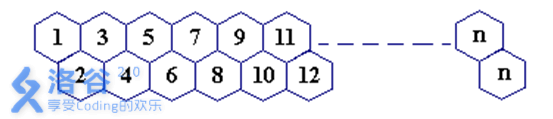
路线数满足斐波那契递推,距离为 d 时答案为第 d+1 项。
OJ: luogu
题目 ID: P2437
难度:入门
标签:动态规划递推python
日期: 2026-07-15 22:00
题意
蜜蜂只能从编号小的蜂房走到编号大的相邻蜂房。给定 m < n,求从 m 到 n 的路线数。
思路
这个蜂房路线模型的递推与斐波那契数相同。
设距离 d = n - m。从起点到终点的路线数满足:
text
ways[0] = 1
ways[1] = 1
ways[d] = ways[d-1] + ways[d-2]因此答案是斐波那契式递推的第 d 项。
小 DP 表
| d | 0 | 1 | 2 | 3 | 4 | 5 |
|---|---|---|---|---|---|---|
| ways[d] | 1 | 1 | 2 | 3 | 5 | 8 |
样例 1 -> 14,距离为 13,答案为 377。
Python 知识
- Python 大整数可以直接处理路线数。
previous, current = current, previous + current是滚动递推常用写法。map(int, input().split())读取一行两个整数。
参考笔记:
/home/rainboy/mycode/hugo-blog/content/program_language/python/math_tools.md/home/rainboy/mycode/hugo-blog/content/program_language/python/input_output_and_strings.md
代码
python
m, n = map(int, input().split())
distance = n - m
previous = 1
current = 1
for _ in range(distance):
previous, current = current, previous + current
print(previous)cpp
/**
* Author by Rainboy blog: https://rainboylv.com github: https://github.com/rainboylvx
* rbook: -> https://rbook.roj.ac.cn https://rbook2.roj.ac.cn
* rainboy的学习导航网站: https://idx.roj.ac.cn
* create_at: 2026-07-27 00:00
* update_at: 2026-07-27 00:00
*/
#include <bits/stdc++.h>
using namespace std;
int m, n;
char a[300], b[300], c[300];
void add(char *res, char *x, char *y) {
int lenx = strlen(x), leny = strlen(y);
int carry = 0, k = 0, i = lenx - 1, j = leny - 1;
while (i >= 0 || j >= 0 || carry) {
int sum = carry;
if (i >= 0) sum += x[i--] - '0';
if (j >= 0) sum += y[j--] - '0';
carry = sum / 10;
res[k++] = sum % 10 + '0';
}
res[k] = '\0';
reverse(res, res + k);
}
int main() {
cin >> m >> n;
int d = n - m;
strcpy(a, "1");
strcpy(b, "1");
for (int i = 0; i < d; i++) {
add(c, a, b);
strcpy(a, b);
strcpy(b, c);
}
cout << a << endl;
return 0;
}Pythonic 写法
滚动递推:
python
m, n = map(int, input().split())
a = b = 1
for _ in range(n - m):
a, b = b, a + b
print(a)复杂度
时间复杂度为
总结
本题和数楼梯一样,是斐波那契递推模型;区别只是把“台阶距离”换成了“蜂房编号差”。