[NOIP 2000 普及组] 税收与补贴问题
把每个竞争售价转成关于税收或补贴 k 的一次严格不等式,和目标价对应约束求交集后,直接取绝对值最小的整数解。
OJ: luogu
题目 ID: P1023
难度:普及+/提高
标签:模拟枚举分段函数思维
日期: 2026-06-20 09:42
题意
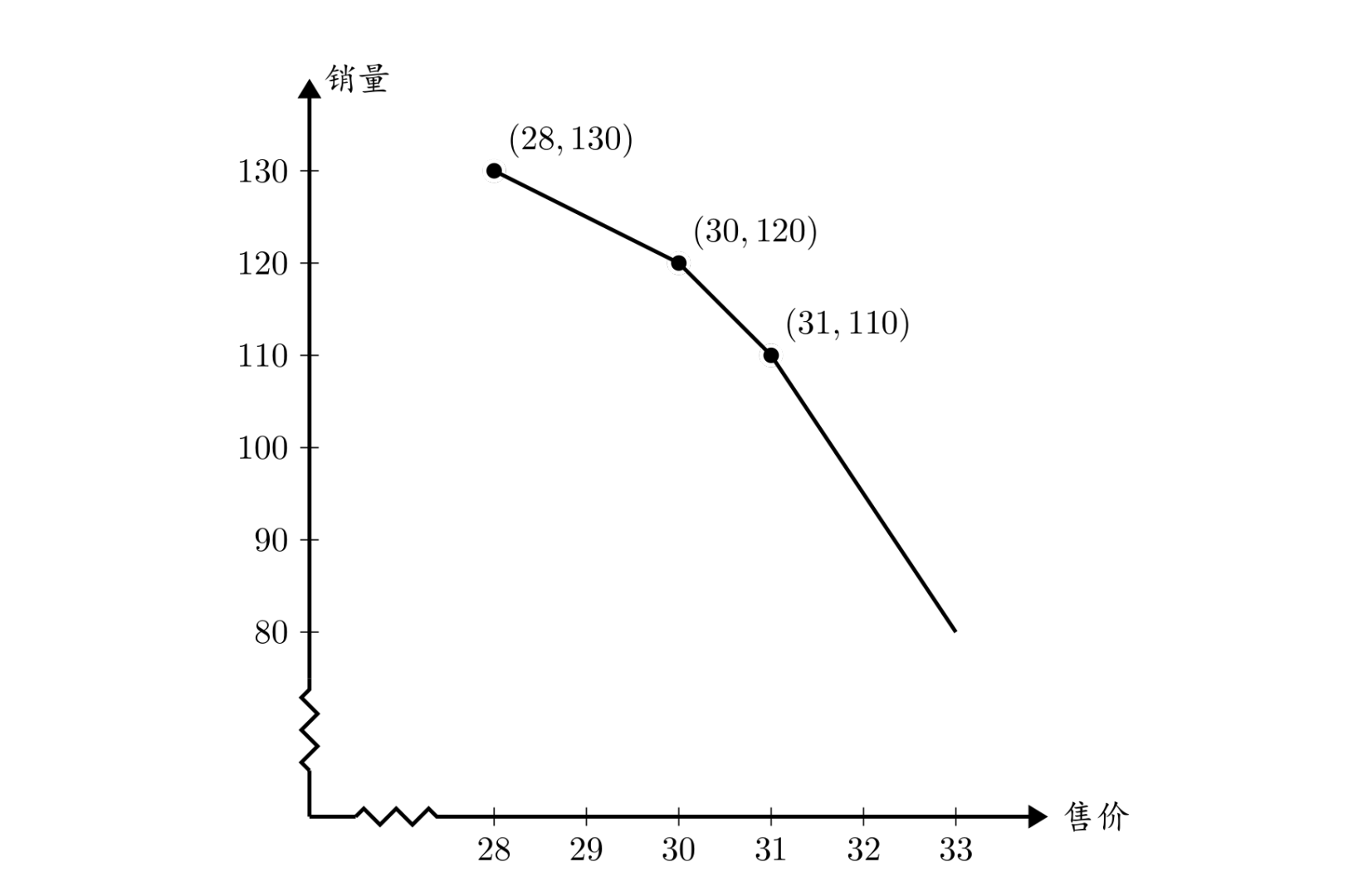
给出一个商品的成本价、若干个“售价-销量”已知点,以及超过最后一个已知点后销量的线性下降速度。
要求找到一个整数税收或补贴金额,使得商家把售价定在政府预期售价时,获得的总利润严格大于其他所有可选售价,并且这个税收/补贴金额的绝对值最小。
思路
先看一个可以直接验证想法的朴素解:
cpp
#include <bits/stdc++.h>
using namespace std;
using i64 = long long;
const int MAXM = 100005;
struct Fraction {
i64 num; // 分子
i64 den; // 分母,恒为正数
};
int target_price;
int point_cnt;
int tail_drop;
int raw_price[MAXM], raw_sale[MAXM];
// brute.cpp:教学用暴力。
// 直接枚举整数 k,并按题意计算每个价格下的销量和利润。
int cmp_fraction(Fraction a, Fraction b) {
__int128 left = (__int128) a.num * b.den;
__int128 right = (__int128) b.num * a.den;
if (left < right) {
return -1;
}
if (left > right) {
return 1;
}
return 0;
}
Fraction get_sale_fraction(int x) {
for (int i = 1; i < point_cnt; i++) {
int x1 = raw_price[i];
int y1 = raw_sale[i];
int x2 = raw_price[i + 1];
int y2 = raw_sale[i + 1];
if (x1 <= x && x <= x2) {
i64 num = 1LL * y1 * (x2 - x1) + 1LL * (y2 - y1) * (x - x1);
i64 den = x2 - x1;
return {num, den};
}
}
int last_price = raw_price[point_cnt];
int last_sale = raw_sale[point_cnt];
return {1LL * last_sale - 1LL * tail_drop * (x - last_price), 1};
}
int get_upper_price() {
int last_price = raw_price[point_cnt];
int last_sale = raw_sale[point_cnt];
if (tail_drop == 0) {
return last_price;
}
return last_price + (last_sale - 1) / tail_drop;
}
// 返回售价 x 在税收/补贴 k 下的总利润。
// 这里利润也保存成分数,避免插值时的除法误差。
Fraction get_profit(int x, int k, int cost_price) {
Fraction sale = get_sale_fraction(x);
return {sale.num * (x - cost_price + k), sale.den};
}
bool check(int k, int cost_price, int upper_price) {
if (target_price < cost_price || target_price > upper_price) {
return false;
}
Fraction target_sale = get_sale_fraction(target_price);
if (target_sale.num <= 0) {
return false;
}
Fraction target_profit = get_profit(target_price, k, cost_price);
for (int x = cost_price; x <= upper_price; x++) {
if (x == target_price) {
continue;
}
Fraction sale = get_sale_fraction(x);
if (sale.num <= 0) {
continue;
}
Fraction profit = get_profit(x, k, cost_price);
if (cmp_fraction(profit, target_profit) >= 0) {
return false;
}
}
return true;
}
int main() {
ios::sync_with_stdio(false);
cin.tie(nullptr);
cin >> target_price;
while (true) {
int x, y;
cin >> x >> y;
if (x == -1 && y == -1) {
break;
}
raw_price[++point_cnt] = x;
raw_sale[point_cnt] = y;
}
cin >> tail_drop;
int cost_price = raw_price[1];
int upper_price = get_upper_price();
// 暴力范围开大一些,供随机对拍使用。
for (int d = 0; d <= 2000; d++) {
if (check(d, cost_price, upper_price)) {
cout << d << '\n';
return 0;
}
if (d != 0 && check(-d, cost_price, upper_price)) {
cout << -d << '\n';
return 0;
}
}
cout << "NO SOLUTION\n";
return 0;
}这题本质上没有复杂数据结构,关键是把题意翻译成正确的不等式。
先约定:
k > 0表示补贴k < 0表示税收- 利润函数是:
profit(price) = (price - cost + k) * sale(price)
其中 sale(price) 是一个离散的分段线性函数:
- 在相邻给定点之间做整数线性插值
- 超过最后一个点后按固定斜率递减
设目标售价是 tp,某个竞争售价是 x,它们对应销量分别是 st 和 sx。
若目标价要严格更优,就必须满足:
(tp - cost + k) * st > (x - cost + k) * sx
移项后得到一个关于 k 的一次严格不等式:
k * (st - sx) > (x - cost) * sx - (tp - cost) * st
也就是说:
- 每个竞争价格
x都会对k给出一个限制 - 所有限制同时成立时,目标价才会成为唯一最优点
于是做法变成:
- 写一个
get_sale(price),按题意求出某个售价的销量 - 枚举所有可能和目标价竞争的整数售价
x - 把“目标价利润严格大于
x的利润”改写成对k的上下界限制 - 把所有限制求交集
- 在可行整数区间里取绝对值最小的
k
一个小表格
| 量 | 含义 |
|---|---|
price |
商家选择的售价 |
sale(price) |
该售价下的销量 |
k |
税收/补贴金额,补贴为正,税收为负 |
profit(price) |
总利润 |
这里还有两个细节:
- 题目要求的是严格最大,所以遇到“相等利润”也算不合法
- 如果目标价本身已经没有正销量,或者所有限制求交后区间为空,就输出
NO SOLUTION
代码
cpp
#include <bits/stdc++.h>
using namespace std;
using i64 = long long;
const int MAXM = 100005;
const i64 INF64 = (1LL << 60);
struct Fraction {
i64 num; // 分子
i64 den; // 分母,恒为正数
};
int target_price;
int point_cnt;
int tail_drop;
int raw_price[MAXM], raw_sale[MAXM];
// 比较两个分数 a 和 b 的大小,返回:
// -1: a < b
// 0: a = b
// 1: a > b
int cmp_fraction(Fraction a, Fraction b) {
__int128 left = (__int128) a.num * b.den;
__int128 right = (__int128) b.num * a.den;
if (left < right) {
return -1;
}
if (left > right) {
return 1;
}
return 0;
}
// 计算 floor(a / b),其中 b > 0,支持 a 为负数。
i64 floor_div(i64 a, i64 b) {
if (a >= 0) {
return a / b;
}
return -((-a + b - 1) / b);
}
// 计算 ceil(a / b),其中 b > 0,支持 a 为负数。
i64 ceil_div(i64 a, i64 b) {
if (a >= 0) {
return (a + b - 1) / b;
}
return -((-a) / b);
}
// 返回售价 x 对应的销量。
// 为了避免中间插值产生误差,这里把销量写成分数。
Fraction get_sale_fraction(int x) {
for (int i = 1; i < point_cnt; i++) {
int x1 = raw_price[i];
int y1 = raw_sale[i];
int x2 = raw_price[i + 1];
int y2 = raw_sale[i + 1];
if (x1 <= x && x <= x2) {
i64 num = 1LL * y1 * (x2 - x1) + 1LL * (y2 - y1) * (x - x1);
i64 den = x2 - x1;
return {num, den};
}
}
int last_price = raw_price[point_cnt];
int last_sale = raw_sale[point_cnt];
return {1LL * last_sale - 1LL * tail_drop * (x - last_price), 1};
}
// 计算某个给定售价下,销量变成非正数前最后还需要检查到哪个价格。
int get_upper_price() {
int last_price = raw_price[point_cnt];
int last_sale = raw_sale[point_cnt];
if (tail_drop == 0) {
// 题面通常不会出现这种情况;若真的出现,销量不会继续下降,
// 说明高价可以无限延伸,这时利润不会有唯一最大值。
return last_price;
}
// 当销量 > 0 时才有意义,所以只需检查到最后一个正销量价格。
return last_price + (last_sale - 1) / tail_drop;
}
int main() {
ios::sync_with_stdio(false);
cin.tie(nullptr);
cin >> target_price;
while (true) {
int x, y;
cin >> x >> y;
if (x == -1 && y == -1) {
break;
}
raw_price[++point_cnt] = x;
raw_sale[point_cnt] = y;
}
cin >> tail_drop;
int cost_price = raw_price[1];
int upper_price = get_upper_price();
// 目标价本身如果已经没有正销量,那么一定无解。
Fraction target_sale = get_sale_fraction(target_price);
if (target_price < cost_price || target_price > upper_price || target_sale.num <= 0) {
cout << "NO SOLUTION\n";
return 0;
}
// 对每个竞争价格 x,都有:
// (tp - cost + k) * st > (x - cost + k) * sx
// 化简成:
// k * (st - sx) > (x - cost) * sx - (tp - cost) * st
// 这是关于 k 的一次严格不等式。
i64 low = -INF64; // k 的下界,满足 k >= low
i64 high = INF64; // k 的上界,满足 k <= high
for (int x = cost_price; x <= upper_price; x++) {
if (x == target_price) {
continue;
}
Fraction sale_x = get_sale_fraction(x);
if (sale_x.num <= 0) {
continue;
}
__int128 a128 = (__int128) target_sale.num * sale_x.den - (__int128) sale_x.num * target_sale.den;
__int128 b128 = (__int128) (x - cost_price) * sale_x.num * target_sale.den
- (__int128) (target_price - cost_price) * target_sale.num * sale_x.den;
i64 a = (i64) a128;
i64 b = (i64) b128;
if (a == 0) {
// 这时不等式退化成 0 > b。
// 若不成立,说明无论怎么调税收/补贴,目标价都无法严格更优。
if (!(0 > b)) {
cout << "NO SOLUTION\n";
return 0;
}
continue;
}
if (a > 0) {
// k > b / a,所以 k >= floor(b / a) + 1
low = max(low, floor_div(b, a) + 1);
}
else {
// k < b / a。
// 由于 a < 0,改写成 k * (-a) < (-b),其中 (-a) > 0。
// 对整数来说,等价于:
// k <= ceil((-b) / (-a)) - 1
high = min(high, ceil_div(-b, -a) - 1);
}
}
if (low > high) {
cout << "NO SOLUTION\n";
return 0;
}
// 在整数区间 [low, high] 中找绝对值最小的 k。
i64 answer;
if (low <= 0 && 0 <= high) {
answer = 0;
}
else if (high < 0) {
answer = high;
}
else {
answer = low;
}
cout << answer << '\n';
return 0;
}复杂度
- 设给出的已知点数量为
m,可行整数售价数量为P - 求每个售价的限制时,需要沿分段函数找到它落在哪一段
- 总复杂度约为
- 空间复杂度
总结
这题最容易出错的不是复杂度,而是下面几个细节:
- 补贴要加到单位利润里
- 税收要从单位利润里减掉
- 目标价必须严格优于其他所有售价,不能并列
- 相邻已知点之间的销量是线性插值
- 最后一个点之后如果无论怎么调都无法让目标价最优,要输出
NO SOLUTION